Categories
Uncategorized

Week 7: Working with what you’ve got

Nothing super exciting happened this past week. Here are my goal updates.

Goals that I implemented:

  • Tool 1 Stop Shopping goal: no new things except food and gas/try to buy local if new
    • Update: Naught added to the fund.
  • Tool 2 Grow Some Food goal: plant beans in a pot
    • Update: Beany babies getting bigger.
  • Tool 4 Buy Local goal: buy from local restaurants and no chains/fast food
    • Update: $3 in fund for frozen chai tea from Wawa (in a paper cup, of course).
  • Tool 5 Turn Off The Lights goal: no phone until after breakfast and computer off by 9:30pm
    • Update: I had my computer on later than 9:30pm once, so $1 added to the fund.
  • Tool 6 Consume Less Plastic goal: $5 fine for any disposable plastic utensils/straws/plates/cups
    • Update: Naught added to the fund.
  • Tool 9 Clean Your Closet goal: donate things I don’t need
    • Update: Returned my Nike shoes that I no longer wanted and recycled my old shoes that had holes in the bottoms.
  • Tool 10 Track Your Trash goal: turn off water in shower when not rinsing
    • Update: Naught added to the fund.
  • Started tracking time volunteering and interning and working.

Goals that I still need to implement:

  • Tool 3 Eat Local goals: look into and try to visit more Orlando and Kissimmee farmers markets and local produce, specifically through IDEAS for Us; start tracking meatless day/part-time vegetarian, in addition to already eating mostly plant-based
  • Tool 6 Consume Less Plastic goal: consider a mini-goal of only buying products with recyclable packaging for a certain amount of time
  • Tool 10 Track Your Trash goals: research waste collection/recycling in Orlando and Kissimmee, look into visiting a landfill, look into composting, consider doing a waste/water audit and carrying trash, research reusable feminine products, consider not using paper towels for personal bathroom trips for a certain amount of time
  • Tool 11 Guzzle Less Gas goals: begin tracking gas usage and train usage, calculate my carbon footprint, ultimately donate to offset fund at the end of the four months, conduct cost-benefit analysis of trading in my RAV4 for a hybrid or electric car
  • Additional goals: find and apply to interesting summer opportunities/beyond, determine motivation months based on larger-scale goals
  • Nothing New Fund this week: $4; Current total: $58

Now that it is Day 50 of my four months of nothing new, I finally started analyzing where I spend my time on a weekly basis. Since January 4th, I have spent 176.25 hours working at the Orlando Science Center and 109 hours volunteering at Give Kids the World, IDEAS For Us, and the Dr. Phillips Center (not including commuting times, which would probably add around 80 hours to the count, to give a rough estimate). According to Independent Sector’s most recent 2018 data, the value of a volunteer hour in Florida was $24.04 per hour, which would mean that I have contributed about $2,620 worth of time to non-profits in my community in the past 50 days alone (in addition to working at a non-profit, which I am paid to do at less than the volunteer hour value rate). Spending my time volunteering is certainly a privilege that I am thankful for, in the sense that I am financially able to work without being paid and I do not have to devote my time to other things out of necessity. Like they say, if you do what you love, you won’t work a day in your life. In my case, it’s because doing what I love is actually volunteering. Although I do enjoy working at the science center, I am not using my skills in the best way and engaging with what I really care about, and my career goal is not to be an educator or teacher. I would prefer to get more involved with sustainability work, perhaps through IDEAS For Us, so I will see what opportunities come my way. Until then, there are worse jobs I could have than one in which I teach kids about engineering (which is somewhat counterintuitively the focus of the majority of our programs, rather than science).

I have two things that I addressed in previous posts on which I will share updates before sharing about what happened today. As Kristin mentions in the Leadership Lessons chapter of her book, A Year of Nothing New, bad shoes should be released because life is long. During my search for places to recycle textiles, I found that Nike’s Reuse-A-Shoe program accepts old athletic shoes that it recycles into new things. The shoes that I bought from Walmart turned out to give me one of the most painless breaking-in periods I have had with shoes in a while, so I felt confident in my ability to get rid of my shoes that had holes in the bottoms. I dropped my old shoes off in the bin in the Nike Clearance Store, and then I also returned my $60 orange athletic shoes that I had bought during a previous trip there, prior to deciding that I would not buy from Nike anymore. In spite of spending multiple hours looking for and trying on shoes to find ones like those, I decided that I can spend that money on better things that will help me decrease my footprint instead of leaving more.
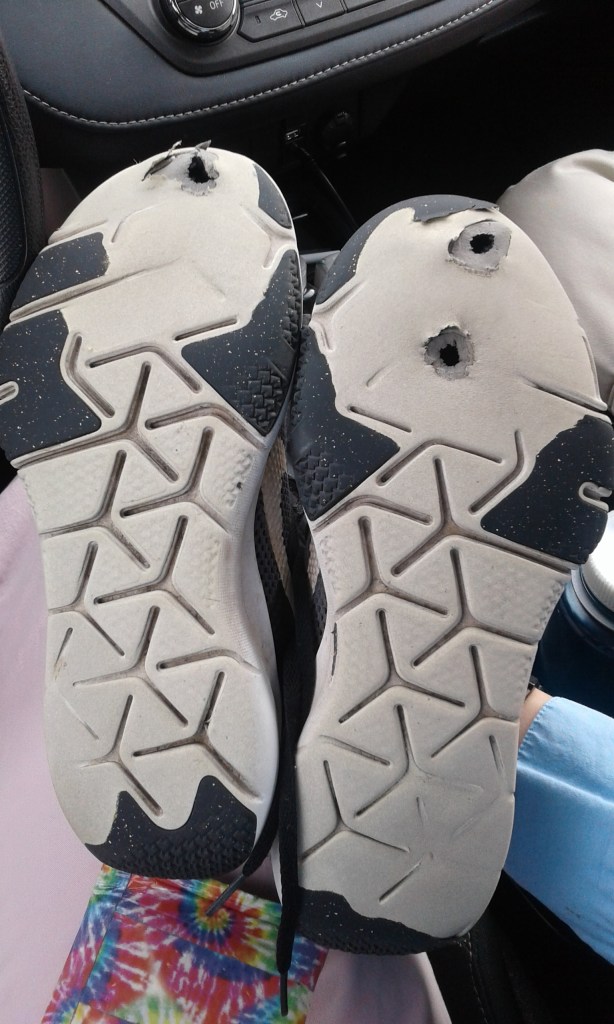
My holey shoes. Also, my homemade duct tape wallet, which is my third since I started making them for myself five years and a few months ago.
Re-Use-A-Shoe bin in the Nike Clearance Store.

I was also able to recycle my polystyrene bowl that I had received during a previous week at Publix today. Most places unfortunately do not recycle polystyrene (brand named Styrofoam), which is plastic number 6, because it is so lightweight and therefore costs more to recycle, but Publix does.

Publix recycling bin out front.

Something else that happened today was that I was given the opportunity to switch to a newer phone. I could have switched to one of two newer used phones that we already had from my sister (who was buying new ones), or I could have gotten a new phone entirely. I ended up declining all offers on the basis of naught new and not wanting the hassle of changing from the phone that I am used to and the only smart phone that I have ever owned (since I first got it during the summer of 2017 as a requirement for my study abroad program in India). I haven’t deliberately researched smart phones since I have no interest in getting a new one until the one that I have completely breaks (and the same goes for my seven-year-old laptop which is still going strong), but the rate at which they are updated and the newest versions sold seems incredibly unsustainable, given that they are made from a limited amount of precious metals mined from the Earth. All of the deals that you can get with service and data plans and upgrades that provide you with a new phone “for free” epitomize the problem of environmental externalities in a consumption-based economic system that values short-term profits over long-term benefits and the reduction of environmental degradation. In case you don’t speak economics, an externality is an unintended consequence of producing and consuming a product that is felt by a third party, or put another way, a cost that is not factored into the cost of a product. Environmental externalities include things like pollution, the deforestation of vital rainforests, and the depletion of precious metals. The willingness that people have to get a new phone for the sake of having the latest edition while their current phone works perfectly well is the result of disregarding the hidden costs to our planet because they don’t have to pay for it personally. Hopefully you think twice about getting a new phone when the next edition comes out (I’m looking at you, iPhone 12).

Researching the environmental impacts that we as consumers are responsible for is a double-edged sword of sorts. It can be discouraging to think about how much environmental degradation we are each causing, but at the same time, there is comfort in the fact that we can clear our conscience by controlling our individual contributions through our purchasing decisions. If it ain’t broke, don’t buy a new one, and may thee use naught new.

I’ve always loved this song (and Captain Eo in general), and someday I will finish learning the dance routine.
Categories
Uncategorized

Week 3: Busy as can be

This week, I started a grant-writing internship with IDEAS For Us, a sustainability-focused non-profit in Orlando, so that’s what I will be doing on Wednesdays and Fridays until the end of April. I started working with the organization back in August to help plan the September 20th and December 6th Orlando climate strikes, so it wasn’t that far of a leap to get more involved. We are currently planning the next global climate strike for April 22nd, which will be the 50th anniversary of Earth Day, so I highly encourage you to plan to attend a local strike. You’ll be able to find a local strike on this website once people start registering their events: https://strikewithus.org/. I’m also starting my training to volunteer at the Dr. Phillips Center for the Performing Arts on the weekends in addition to volunteering at Give Kids the World in the evenings, so I’m definitely filling my time with commitments. Unless I start signing up for five-hour Dr. Phillips Center shifts on the weekends (and I already have a few for tomorrow, next Saturday, and next Sunday), I usually have those days off to work on my nothing new goals, as follows.

Goals that I implemented:

  • Tool 1 Stop Shopping goal: no new things except food and gas/try to buy local if new
    • Update: $10 added to fund for new shoes; I also bought a $5 postcard, but I’m not adding to the fund for it because it was art from a local artist and I declined the plastic sleeve that it could come in.
  • Tool 2 Grow Some Food goal: plant beans in a pot
    • Update: I finally did it today, January 25th.
  • Tool 4 Buy Local goal: buy from local restaurants and no chains/fast food
    • Update: 1 local, plant-based restaurant
  • Tool 5 Turn Off The Lights goal: no phone until after breakfast and computer off by 9:30pm
    • Update: I had my computer on later than 9:30pm once, so $1 added to the fund.
  • Tool 6 Consume Less Plastic goal: $5 fine for any disposable plastic utensils/straws/plates/cups
    • Update: $10 added to fund for a small plastic plate and cup
  • Tool 7 Detox Yourself goal: detox laundry detergent
    • Update: After some internet research, I bought Seventh Generation Free and Clear, which is 97% bio-based, which to me is far superior to the cheapest detergents that don’t even have their ingredients listed. I’m not adding it to the fund because it is for my household and rather necessary for cleaning clothes.
  • Tool 8 Make Stuff goal: make things and use what I have for gifts
    • Update: Done
  • Tool 9 Clean Your Closet goal: donate things I don’t need and research textile recycling
    • Update: Most of my clothes donations were picked up today by Red Cross. I did some online research on textile recycling for old clothes that are no longer usable, and according to this article, Salvation Army sends what they cannot sell in their stores to be recycled as rags, which is better than throwing it in the landfill. Another option is to buy a TerraCycle box, but because I only had a few pairs of old shorts, that was not a cost-effective option for me. I included my old shorts with some books and other things that I donated to Salvation Army today.
  • Tool 10 Track Your Trash goal: turn off water in shower when not rinsing
    • Update: Ongoing
Shoes, laundry detergent, and a Michael Jackson art print were things I bought this week.

Goals that I still need to implement:

  • Tool 3 Eat Local goals: look into and try to visit more Orlando and Kissimmee farmers markets and local produce, specifically through IDEAS For Us; start tracking meatless day/part-time vegetarian, because I already eat mostly plant-based, but I don’t keep track
  • Tool 6 Consume Less Plastic goal: consider a mini-goal of only buying products with recyclable packaging for a certain amount of time or All-In-One Zero Waste Box from TerraCycle
  • Tool 10 Track Your Trash goals: research waste collection/recycling in Orlando and Kissimmee, look into visiting a landfill, look into composting, consider doing a waste/water audit and carrying trash, research reusable feminine products, consider not using paper towels for personal bathroom trips for a certain amount of time
  • Tool 11 Guzzle Less Gas goals: begin tracking gas usage and train usage, calculate my carbon footprint, ultimately donate to offset fund at the end of the four months, conduct cost-benefit analysis of trading in my RAV4 for a hybrid or electric car
  • Additional goals: track time volunteering and interning and working, find and apply to interesting summer opportunities, determine motivation months based on larger-scale goals

Nothing New Fund this week: $21; Current total: $35

It looks like the goals that I still need to implement are mainly associated with eating local food, tracking my trash, and starting to calculate my gas versus train usage and how I spend my time. Now for a story.

I noted above that I am putting $10 into my fund for buying new shoes. I bought a pair of black shoes for $10 today from Walmart because I need completely black shoes with no logos to comply with the Dr. Phillips Center dress code, and my first volunteer training shift is tomorrow. Plus, both of the pairs of shoes that I currently wear have holes in the bottoms, so I am ready to not have wet feet when the ground is wet and to stop making holes in my socks. Yes, I wear my shoes until they literally have holes in the bottoms in order to make the most of them as a sustainable practice, but there is another, more compelling reason.

I started buying my shoes from Nike Clearance Store in high school for sports, and I’ve been shopping there and at Sketchers for shoes pretty much ever since. For the past six years or so, I have been paying more than I would like to for a pair of shoes, generally between $30 and $50. I do a lot of moving around, so I wanted high-quality athletic shoes that would last. It didn’t occur to me before, but I recently saw something that someone posted online about how Nike workers get paid low wages and work long hours, so I’m now trying Walmart shoes and planning not to buy from Nike anymore. Not that Walmart has a great record or anything, but it’s cheap. In addition to being much cheaper, Walmart shoes so far seem to fit better, so hopefully they are good enough for standing, walking, and jumping in.

Although my desire to live sustainably and frugally contributes to how long I wear shoes, the more compelling reason is my feet. Back in eighth grade, I had an arch injury while playing basketball that was caused in large part by a lack of arch support in the shoes that I wore. The injury was never really diagnosed, in spite of how I explained it to my doctor and a podiatrist. The prescription that I was given was to always wear arch supports in my shoes, which I have done with every pair of shoes that I have worn ever since. Arch supports, which many people wear for comfort or ergonomics, are what allow me to continue to jump and dance and run and walk. However, a fact of my life since the injury and part of the prescription from the podiatrist is that I can no longer walk barefoot for more than a few steps before I need to put my shoes back on. Because my arches, specifically the arch in my left foot where the injury took place, are so sensitive, it takes me a while to break in new shoes, and unfortunately I have often had to return shoes that I just could not wear because they were hurting my arch too much while I tried to break them in. It gives a whole new meaning to walking a mile in my shoes.

The point of my story is to say that necessity is not only the mother of invention, but also the mother of sustainability. If I didn’t have “messed-up” feet, which is how I endearingly refer to them, then I most likely would not wear shoes for as long as I do. The limiting factor for new purchases for many people in our global human population is limited funds, and so they make do with what they already have and are content and capable of doing so. Besides shoes, I haven’t bought new clothes in years, aside from the occasional costume pieces for Halloween or other events, which I generally buy used from Salvation Army or Goodwill. As long as I’m not growing or shrinking (which I haven’t since about my junior year of high school), then I don’t see any reason to buy new clothes. After a year in AmeriCorps NCCC wearing the same three or four sets of uniforms and two or three of my own outfits, I came home and felt like I had so many clothes that I did not need. As Kristin discusses in her book A Year of Nothing New (which I, again, encourage you to buy used/borrow and read), a fashion fast (instead of fast fashion) of only wearing a certain number of outfits can change your perspective on how much you really need. Live simply and may thee use naught new.

I love this album because it’s so encouraging. This song reminds me that the only thing that we as individuals can do to change the world is our very best.
Create your own website, free on WordPress.com.Create your own website.
Start free