Categories
Uncategorized

Week 13: Menstrual cycling, bicycling, and recycling

Three months down, one more to go. Of course my nothing new journey of living a low impact life will continue after my four months are up, but it may look different depending on where life takes me next.

Goals that I implemented:

  • Tool 1 Stop Shopping goal: no new things except food and gas/try to buy local if new
    • Update: Naught added to the fund.
  • Tool 2 Grow Some Food goal: plant beans in a pot
    • Update: Beany babies are still producing a few more beans. I may start growing tomatoes next.
  • Tool 4 Buy Local goal: buy from local restaurants and no chains/fast food
    • Update: Naught added to the fund.
  • Tool 5 Turn Off The Lights goal: no phone until after breakfast and computer off by 9:30pm
    • Update: $5 added to the fund for using my computer past 9:30pm and $1 for phone on one morning. At this point, my schedule has changed so that I’m staying up later and sleeping in later, so I guess I’ll be paying for that.
  • Tool 6 Consume Less Plastic goal: $5 fine for any disposable plastic utensils/straws/plates/cups
    • Update: $10 added to the fund because I used two Ziploc bags to make homemade ice cream (I will try to reuse them at least).
  • Tool 10 Track Your Trash goal: research and purchase reusable cloth feminine products
    • Update: I bought one pad and two liners to try before buying more. I found that the pad was more comfortable than a disposable pad, and of course it reduces a large source of my disposable waste, so I’ll most likely buy some more reusable pads from the same Etsy store, yurtcraft. Reusable pads may sound gross at first, but you can wash them just like your other clothes and they really are more comfortable, so I encourage you to try them out if you are a fellow menstruater! There are also Diva Cups, which are the reusable equivalent of tampons. Check them out as well.
  • Tool 10 Track Your Trash goals: research recycling in Orlando and Kissimmee
    • Update: See my story below.
  • Tool 11 Guzzle Less Gas goal: begin tracking gas/train/bike usage
    • Update: I did not use my car at all and biked a bit. There is a grassy drainage ditch along a dirt road in a nearby park that I bike through as if it is a half-pipe, and that’s the closest I’ll get to mountain biking in Florida. I got the idea in my head that I would like to return to Norton, Virginia, to go mountain biking on the trails I helped build when I was in AmeriCorps NCCC last year, so maybe a road trip will happen at some point when quarantine ends.
  • Continued tracking time.
    • Update: There are so many free concerts, Shakespeare/musical/theater shows, virtual parties, webinars, and PBS shows on my to-watch list that I can hardly keep up. In addition, for the first time ever, I spent time creating a list of my song parodies in order of when I wrote them. I learned how to write parodies in middle school music class in 2009 and really got into writing them in 2012, and my current count is at 265 (the true count is closer to 260). If you are interested, you can read some of them on my other blog, Parodies for Posterity.  
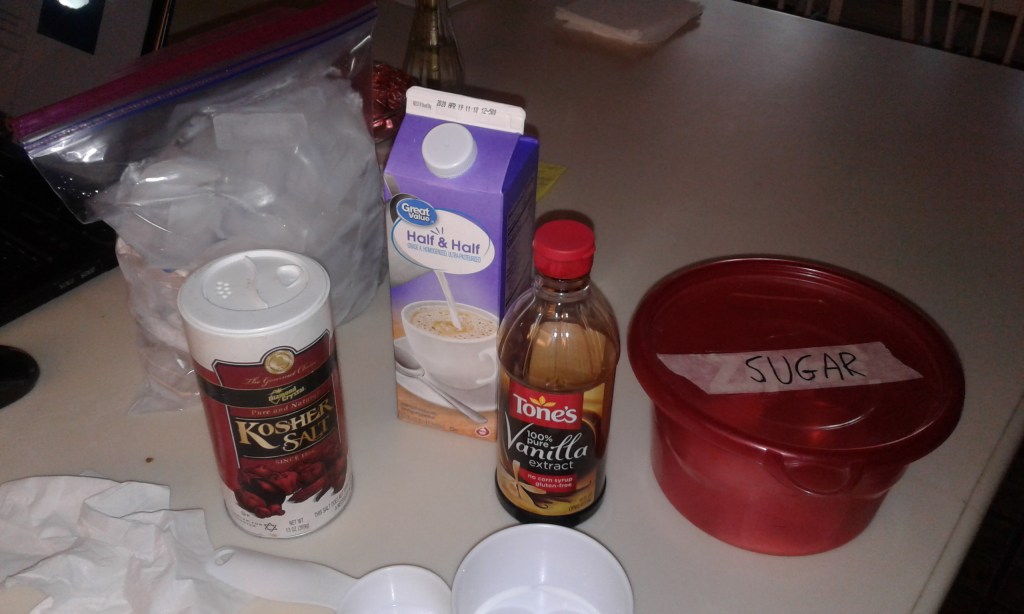
Ingredients for homemade ice cream: half and half, vanilla extract, sugar, salt, and ice.
Ice cream in a bag tastes better than it looks.

Goals that I still need to implement:

  • Tool 3 Eat Local goals: look into IDEAS for Us farmers market; start tracking meatless day/part-time vegetarian, in addition to already eating mostly plant-based
  • Tool 6 Consume Less Plastic goal: consider a mini-goal of only buying products with recyclable packaging for a certain amount of time
  • Tool 10 Track Your Trash goals: look into composting, look into visiting a landfill, consider doing a waste/water audit and carrying trash, consider not using paper towels for personal bathroom trips for a certain amount of time
  • Tool 11 Guzzle Less Gas goals: calculate my carbon footprint, ultimately donate to offset fund at the end of the four months, conduct cost-benefit analysis of trading in my RAV4 for a hybrid or electric car
  • Additional goals: find and apply to interesting summer opportunities/beyond, determine motivation months based on larger-scale goals
  • Nothing New Fund for the past week: $16; Current total: $164

I recently watched various PBS shows about climate change, the oceans, and plastic, and some statistics and facts that I noted are that half of the carbon dioxide that we emit is absorbed by the Earth, with land and trees absorbing a quarter and the oceans absorbing another quarter (which is what is driving ocean acidification and killing coral and thus the most biodiverse underwater ecosystem). In addition, oceans absorb a staggering 93% of the heat that is being trapped in our atmosphere as a result of burning fossil fuels, which is causing ice caps and glaciers to calve, or break off in huge chunks to be carried away and melted. As if acidity and heat pollution in our oceans aren’t enough, we have vast amounts of plastic waste swirling in gyres over double the size of Texas. A sobering statistic on plastic is that humans have created 9 billion, or 9,000,000,000 metric tons of plastic since 1950. All of it still exists in some form on the planet, and we continue to produce a greater amount of plastic each year than we did the previous year. As you can tell from these facts, we have a crisis of planetary proportions on our hands, which is why I think we should all do our best to reduce our personal consumption of plastic.

I live in Kissimmee and work in Orlando, and I finally got around to comparing what can be recycled in both places. Let’s start with what they both recycle. They both recycle cardboard, paper, aluminum/metal cans, and some plastic bottles and containers. Orlando recycles glass but Kissimmee does not, which is a real shame, considering that glass is estimated to take a million years to break down in a landfill, so basically never. You should avoid buying products in glass unless you know for a fact that there is glass recycling in your area or if you plan to reuse the glass container. As for plastic, Orlando recycles numbers 1-5 and Kissimmee probably also recycles numbers 1-5, which are the first five of seven types of plastic. Neither place recycles polystyrene, which is plastic number 6, because most polystyrene is in the form of foam, most commonly known by the brand Styrofoam. Plastic bags and anything contaminated by food are things that cannot be recycled curbside. Plastic bags can be recycled in the front of Publix and probably in some other locations.

There are two major issues with recycling that I want to briefly discuss, because goodness knows this post is already turning into an essay. The first is a phenomenon called “wish-cycling,” in which we throw things we hope can be recycled into the bin without being sure if they can or not. I will disclose that I have definitely been susceptible to this in the past, but upon learning about it, I have since changed my ways. Although it may be painful to throw something away if you think there’s a chance that it is recyclable, you really should follow the motto “when in doubt, throw it out” to avoid contaminating the things that really can be recycled. By not wish-cycling, you reduce the amount of sorting and discarding that has to be done later, and thus improve the chances of recycling things that actually can be recycled.

The second issue I want to address is the fact that so much of our food and other products come in thin plastic wrap that is not recyclable. Although I haven’t done a personal trash audit since college, most of my waste is probably non-recyclable plastic from food. It is so difficult to find affordable food that is not wrapped in plastic. I have not included that type of disposable plastic in my naught new fund since it is so ubiquitous, but one of my additional goals is to only buy food that comes in recyclable plastic (or no plastic at all), so I will eventually try to live as close to a zero-waste lifestyle as I can. To put it economically, there are always going to be trade-offs and diminishing marginal returns. Stop wish-cycling and may thee use naught new.
This song is from Beetlejuice the Musical and is a good representation of my internal struggle to be optimistic while being a climate activist.
Categories
Uncategorized

Week 7: Working with what you’ve got

Nothing super exciting happened this past week. Here are my goal updates.

Goals that I implemented:

  • Tool 1 Stop Shopping goal: no new things except food and gas/try to buy local if new
    • Update: Naught added to the fund.
  • Tool 2 Grow Some Food goal: plant beans in a pot
    • Update: Beany babies getting bigger.
  • Tool 4 Buy Local goal: buy from local restaurants and no chains/fast food
    • Update: $3 in fund for frozen chai tea from Wawa (in a paper cup, of course).
  • Tool 5 Turn Off The Lights goal: no phone until after breakfast and computer off by 9:30pm
    • Update: I had my computer on later than 9:30pm once, so $1 added to the fund.
  • Tool 6 Consume Less Plastic goal: $5 fine for any disposable plastic utensils/straws/plates/cups
    • Update: Naught added to the fund.
  • Tool 9 Clean Your Closet goal: donate things I don’t need
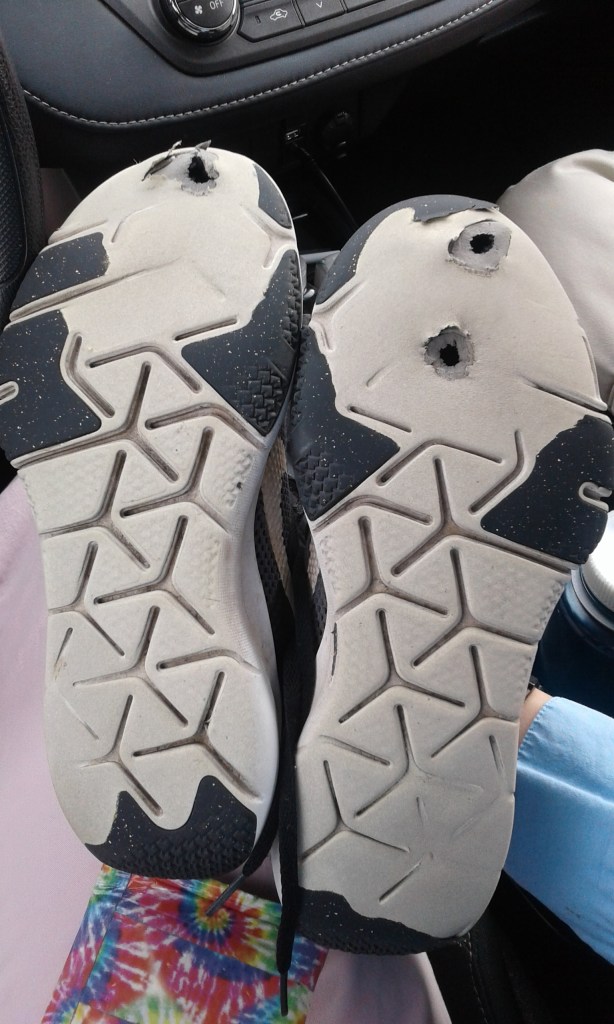
    • Update: Returned my Nike shoes that I no longer wanted and recycled my old shoes that had holes in the bottoms.
  • Tool 10 Track Your Trash goal: turn off water in shower when not rinsing
    • Update: Naught added to the fund.
  • Started tracking time volunteering and interning and working.

Goals that I still need to implement:

  • Tool 3 Eat Local goals: look into and try to visit more Orlando and Kissimmee farmers markets and local produce, specifically through IDEAS for Us; start tracking meatless day/part-time vegetarian, in addition to already eating mostly plant-based
  • Tool 6 Consume Less Plastic goal: consider a mini-goal of only buying products with recyclable packaging for a certain amount of time
  • Tool 10 Track Your Trash goals: research waste collection/recycling in Orlando and Kissimmee, look into visiting a landfill, look into composting, consider doing a waste/water audit and carrying trash, research reusable feminine products, consider not using paper towels for personal bathroom trips for a certain amount of time
  • Tool 11 Guzzle Less Gas goals: begin tracking gas usage and train usage, calculate my carbon footprint, ultimately donate to offset fund at the end of the four months, conduct cost-benefit analysis of trading in my RAV4 for a hybrid or electric car
  • Additional goals: find and apply to interesting summer opportunities/beyond, determine motivation months based on larger-scale goals
  • Nothing New Fund this week: $4; Current total: $58

Now that it is Day 50 of my four months of nothing new, I finally started analyzing where I spend my time on a weekly basis. Since January 4th, I have spent 176.25 hours working at the Orlando Science Center and 109 hours volunteering at Give Kids the World, IDEAS For Us, and the Dr. Phillips Center (not including commuting times, which would probably add around 80 hours to the count, to give a rough estimate). According to Independent Sector’s most recent 2018 data, the value of a volunteer hour in Florida was $24.04 per hour, which would mean that I have contributed about $2,620 worth of time to non-profits in my community in the past 50 days alone (in addition to working at a non-profit, which I am paid to do at less than the volunteer hour value rate). Spending my time volunteering is certainly a privilege that I am thankful for, in the sense that I am financially able to work without being paid and I do not have to devote my time to other things out of necessity. Like they say, if you do what you love, you won’t work a day in your life. In my case, it’s because doing what I love is actually volunteering. Although I do enjoy working at the science center, I am not using my skills in the best way and engaging with what I really care about, and my career goal is not to be an educator or teacher. I would prefer to get more involved with sustainability work, perhaps through IDEAS For Us, so I will see what opportunities come my way. Until then, there are worse jobs I could have than one in which I teach kids about engineering (which is somewhat counterintuitively the focus of the majority of our programs, rather than science).

I have two things that I addressed in previous posts on which I will share updates before sharing about what happened today. As Kristin mentions in the Leadership Lessons chapter of her book, A Year of Nothing New, bad shoes should be released because life is long. During my search for places to recycle textiles, I found that Nike’s Reuse-A-Shoe program accepts old athletic shoes that it recycles into new things. The shoes that I bought from Walmart turned out to give me one of the most painless breaking-in periods I have had with shoes in a while, so I felt confident in my ability to get rid of my shoes that had holes in the bottoms. I dropped my old shoes off in the bin in the Nike Clearance Store, and then I also returned my $60 orange athletic shoes that I had bought during a previous trip there, prior to deciding that I would not buy from Nike anymore. In spite of spending multiple hours looking for and trying on shoes to find ones like those, I decided that I can spend that money on better things that will help me decrease my footprint instead of leaving more.

My holey shoes. Also, my homemade duct tape wallet, which is my third since I started making them for myself five years and a few months ago.
Re-Use-A-Shoe bin in the Nike Clearance Store.

I was also able to recycle my polystyrene bowl that I had received during a previous week at Publix today. Most places unfortunately do not recycle polystyrene (brand named Styrofoam), which is plastic number 6, because it is so lightweight and therefore costs more to recycle, but Publix does.

Publix recycling bin out front.

Something else that happened today was that I was given the opportunity to switch to a newer phone. I could have switched to one of two newer used phones that we already had from my sister (who was buying new ones), or I could have gotten a new phone entirely. I ended up declining all offers on the basis of naught new and not wanting the hassle of changing from the phone that I am used to and the only smart phone that I have ever owned (since I first got it during the summer of 2017 as a requirement for my study abroad program in India). I haven’t deliberately researched smart phones since I have no interest in getting a new one until the one that I have completely breaks (and the same goes for my seven-year-old laptop which is still going strong), but the rate at which they are updated and the newest versions sold seems incredibly unsustainable, given that they are made from a limited amount of precious metals mined from the Earth. All of the deals that you can get with service and data plans and upgrades that provide you with a new phone “for free” epitomize the problem of environmental externalities in a consumption-based economic system that values short-term profits over long-term benefits and the reduction of environmental degradation. In case you don’t speak economics, an externality is an unintended consequence of producing and consuming a product that is felt by a third party, or put another way, a cost that is not factored into the cost of a product. Environmental externalities include things like pollution, the deforestation of vital rainforests, and the depletion of precious metals. The willingness that people have to get a new phone for the sake of having the latest edition while their current phone works perfectly well is the result of disregarding the hidden costs to our planet because they don’t have to pay for it personally. Hopefully you think twice about getting a new phone when the next edition comes out (I’m looking at you, iPhone 12).

Researching the environmental impacts that we as consumers are responsible for is a double-edged sword of sorts. It can be discouraging to think about how much environmental degradation we are each causing, but at the same time, there is comfort in the fact that we can clear our conscience by controlling our individual contributions through our purchasing decisions. If it ain’t broke, don’t buy a new one, and may thee use naught new.

I’ve always loved this song (and Captain Eo in general), and someday I will finish learning the dance routine.
Create your own website, free on WordPress.com.Create your own website.
Start free