Nothing super exciting happened this past week. Here are my goal updates.
Goals that I implemented:
- Tool 1 Stop Shopping goal: no new things except food and gas/try to buy local if new
- Update: Naught added to the fund.
- Tool 2 Grow Some Food goal: plant beans in a pot
- Update: Beany babies getting bigger.
- Tool 4 Buy Local goal: buy from local restaurants and no chains/fast food
- Update: $3 in fund for frozen chai tea from Wawa (in a paper cup, of course).
- Tool 5 Turn Off The Lights goal: no phone until after breakfast and computer off by 9:30pm
- Update: I had my computer on later than 9:30pm once, so $1 added to the fund.
- Tool 6 Consume Less Plastic goal: $5 fine for any disposable plastic utensils/straws/plates/cups
- Update: Naught added to the fund.
- Tool 9 Clean Your Closet goal: donate things I don’t need
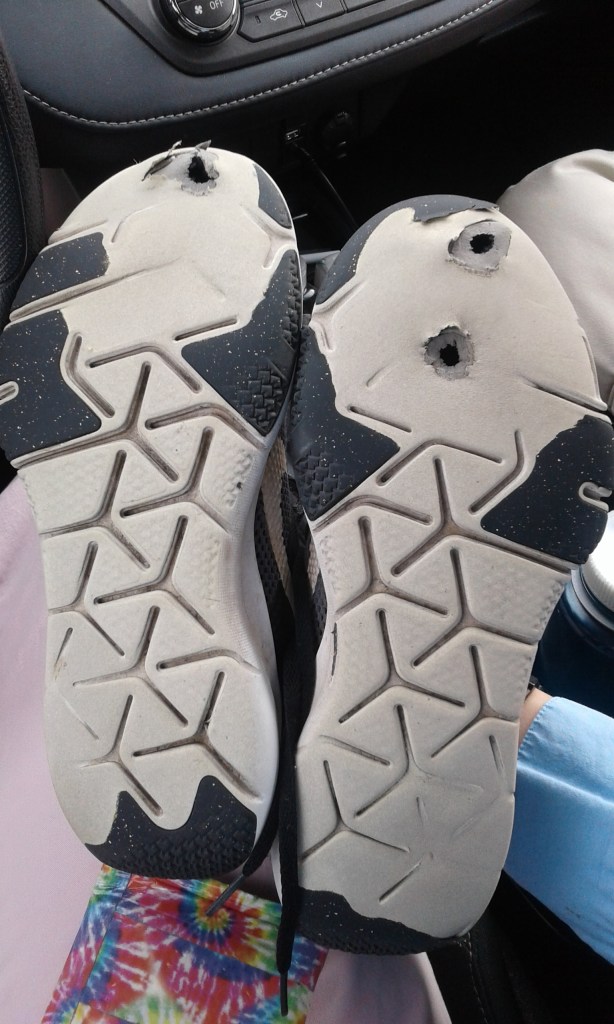
- Update: Returned my Nike shoes that I no longer wanted and recycled my old shoes that had holes in the bottoms.
- Tool 10 Track Your Trash goal: turn off water in shower when not rinsing
- Update: Naught added to the fund.
- Started tracking time volunteering and interning and working.
Goals that I still need to implement:
- Tool 3 Eat Local goals: look into and try to visit more Orlando and Kissimmee farmers markets and local produce, specifically through IDEAS for Us; start tracking meatless day/part-time vegetarian, in addition to already eating mostly plant-based
- Tool 6 Consume Less Plastic goal: consider a mini-goal of only buying products with recyclable packaging for a certain amount of time
- Tool 10 Track Your Trash goals: research waste collection/recycling in Orlando and Kissimmee, look into visiting a landfill, look into composting, consider doing a waste/water audit and carrying trash, research reusable feminine products, consider not using paper towels for personal bathroom trips for a certain amount of time
- Tool 11 Guzzle Less Gas goals: begin tracking gas usage and train usage, calculate my carbon footprint, ultimately donate to offset fund at the end of the four months, conduct cost-benefit analysis of trading in my RAV4 for a hybrid or electric car
- Additional goals: find and apply to interesting summer opportunities/beyond, determine motivation months based on larger-scale goals
- Nothing New Fund this week: $4; Current total: $58
Now that it is Day 50 of my four months of nothing new, I finally started analyzing where I spend my time on a weekly basis. Since January 4th, I have spent 176.25 hours working at the Orlando Science Center and 109 hours volunteering at Give Kids the World, IDEAS For Us, and the Dr. Phillips Center (not including commuting times, which would probably add around 80 hours to the count, to give a rough estimate). According to Independent Sector’s most recent 2018 data, the value of a volunteer hour in Florida was $24.04 per hour, which would mean that I have contributed about $2,620 worth of time to non-profits in my community in the past 50 days alone (in addition to working at a non-profit, which I am paid to do at less than the volunteer hour value rate). Spending my time volunteering is certainly a privilege that I am thankful for, in the sense that I am financially able to work without being paid and I do not have to devote my time to other things out of necessity. Like they say, if you do what you love, you won’t work a day in your life. In my case, it’s because doing what I love is actually volunteering. Although I do enjoy working at the science center, I am not using my skills in the best way and engaging with what I really care about, and my career goal is not to be an educator or teacher. I would prefer to get more involved with sustainability work, perhaps through IDEAS For Us, so I will see what opportunities come my way. Until then, there are worse jobs I could have than one in which I teach kids about engineering (which is somewhat counterintuitively the focus of the majority of our programs, rather than science).
I have two things that I addressed in previous posts on which I will share updates before sharing about what happened today. As Kristin mentions in the Leadership Lessons chapter of her book, A Year of Nothing New, bad shoes should be released because life is long. During my search for places to recycle textiles, I found that Nike’s Reuse-A-Shoe program accepts old athletic shoes that it recycles into new things. The shoes that I bought from Walmart turned out to give me one of the most painless breaking-in periods I have had with shoes in a while, so I felt confident in my ability to get rid of my shoes that had holes in the bottoms. I dropped my old shoes off in the bin in the Nike Clearance Store, and then I also returned my $60 orange athletic shoes that I had bought during a previous trip there, prior to deciding that I would not buy from Nike anymore. In spite of spending multiple hours looking for and trying on shoes to find ones like those, I decided that I can spend that money on better things that will help me decrease my footprint instead of leaving more.

I was also able to recycle my polystyrene bowl that I had received during a previous week at Publix today. Most places unfortunately do not recycle polystyrene (brand named Styrofoam), which is plastic number 6, because it is so lightweight and therefore costs more to recycle, but Publix does.

Something else that happened today was that I was given the opportunity to switch to a newer phone. I could have switched to one of two newer used phones that we already had from my sister (who was buying new ones), or I could have gotten a new phone entirely. I ended up declining all offers on the basis of naught new and not wanting the hassle of changing from the phone that I am used to and the only smart phone that I have ever owned (since I first got it during the summer of 2017 as a requirement for my study abroad program in India). I haven’t deliberately researched smart phones since I have no interest in getting a new one until the one that I have completely breaks (and the same goes for my seven-year-old laptop which is still going strong), but the rate at which they are updated and the newest versions sold seems incredibly unsustainable, given that they are made from a limited amount of precious metals mined from the Earth. All of the deals that you can get with service and data plans and upgrades that provide you with a new phone “for free” epitomize the problem of environmental externalities in a consumption-based economic system that values short-term profits over long-term benefits and the reduction of environmental degradation. In case you don’t speak economics, an externality is an unintended consequence of producing and consuming a product that is felt by a third party, or put another way, a cost that is not factored into the cost of a product. Environmental externalities include things like pollution, the deforestation of vital rainforests, and the depletion of precious metals. The willingness that people have to get a new phone for the sake of having the latest edition while their current phone works perfectly well is the result of disregarding the hidden costs to our planet because they don’t have to pay for it personally. Hopefully you think twice about getting a new phone when the next edition comes out (I’m looking at you, iPhone 12).
Researching the environmental impacts that we as consumers are responsible for is a double-edged sword of sorts. It can be discouraging to think about how much environmental degradation we are each causing, but at the same time, there is comfort in the fact that we can clear our conscience by controlling our individual contributions through our purchasing decisions. If it ain’t broke, don’t buy a new one, and may thee use naught new.
 Naught New