Three months down, one more to go. Of course my nothing new journey of living a low impact life will continue after my four months are up, but it may look different depending on where life takes me next.
Goals that I implemented:
- Tool 1 Stop Shopping goal: no new things except food and gas/try to buy local if new
- Update: Naught added to the fund.
- Tool 2 Grow Some Food goal: plant beans in a pot
- Update: Beany babies are still producing a few more beans. I may start growing tomatoes next.
- Tool 4 Buy Local goal: buy from local restaurants and no chains/fast food
- Update: Naught added to the fund.
- Tool 5 Turn Off The Lights goal: no phone until after breakfast and computer off by 9:30pm
- Update: $5 added to the fund for using my computer past 9:30pm and $1 for phone on one morning. At this point, my schedule has changed so that I’m staying up later and sleeping in later, so I guess I’ll be paying for that.
- Tool 6 Consume Less Plastic goal: $5 fine for any disposable plastic utensils/straws/plates/cups
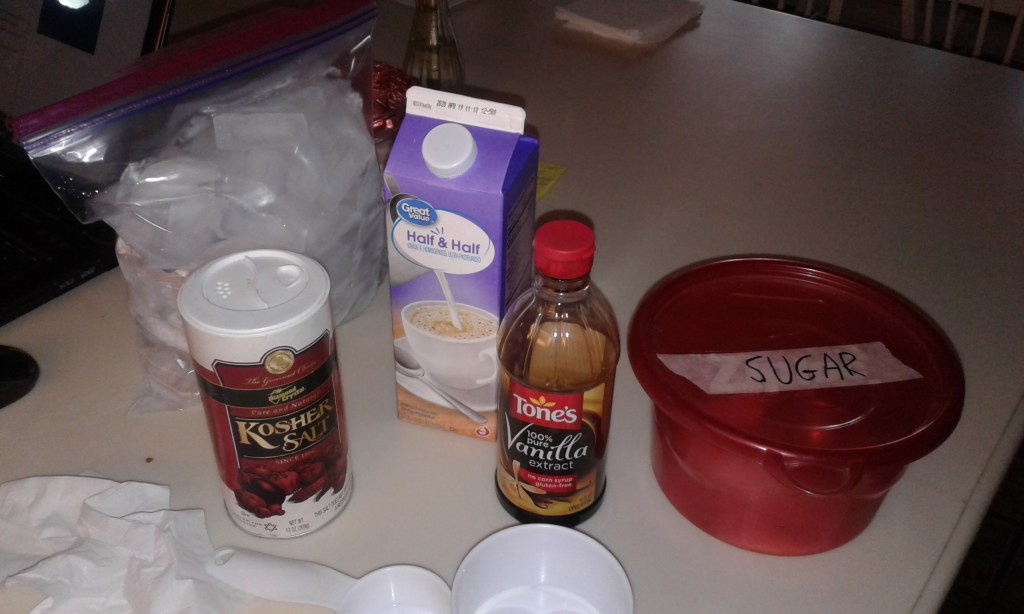
- Update: $10 added to the fund because I used two Ziploc bags to make homemade ice cream (I will try to reuse them at least).
- Tool 10 Track Your Trash goal: research and purchase reusable cloth feminine products
- Update: I bought one pad and two liners to try before buying more. I found that the pad was more comfortable than a disposable pad, and of course it reduces a large source of my disposable waste, so I’ll most likely buy some more reusable pads from the same Etsy store, yurtcraft. Reusable pads may sound gross at first, but you can wash them just like your other clothes and they really are more comfortable, so I encourage you to try them out if you are a fellow menstruater! There are also Diva Cups, which are the reusable equivalent of tampons. Check them out as well.
- Tool 10 Track Your Trash goals: research recycling in Orlando and Kissimmee
- Update: See my story below.
- Tool 11 Guzzle Less Gas goal: begin tracking gas/train/bike usage
- Update: I did not use my car at all and biked a bit. There is a grassy drainage ditch along a dirt road in a nearby park that I bike through as if it is a half-pipe, and that’s the closest I’ll get to mountain biking in Florida. I got the idea in my head that I would like to return to Norton, Virginia, to go mountain biking on the trails I helped build when I was in AmeriCorps NCCC last year, so maybe a road trip will happen at some point when quarantine ends.
- Continued tracking time.
- Update: There are so many free concerts, Shakespeare/musical/theater shows, virtual parties, webinars, and PBS shows on my to-watch list that I can hardly keep up. In addition, for the first time ever, I spent time creating a list of my song parodies in order of when I wrote them. I learned how to write parodies in middle school music class in 2009 and really got into writing them in 2012, and my current count is at 265 (the true count is closer to 260). If you are interested, you can read some of them on my other blog, Parodies for Posterity.

Goals that I still need to implement:
- Tool 3 Eat Local goals: look into IDEAS for Us farmers market; start tracking meatless day/part-time vegetarian, in addition to already eating mostly plant-based
- Tool 6 Consume Less Plastic goal: consider a mini-goal of only buying products with recyclable packaging for a certain amount of time
- Tool 10 Track Your Trash goals: look into composting, look into visiting a landfill, consider doing a waste/water audit and carrying trash, consider not using paper towels for personal bathroom trips for a certain amount of time
- Tool 11 Guzzle Less Gas goals: calculate my carbon footprint, ultimately donate to offset fund at the end of the four months, conduct cost-benefit analysis of trading in my RAV4 for a hybrid or electric car
- Additional goals: find and apply to interesting summer opportunities/beyond, determine motivation months based on larger-scale goals
- Nothing New Fund for the past week: $16; Current total: $164
I recently watched various PBS shows about climate change, the oceans, and plastic, and some statistics and facts that I noted are that half of the carbon dioxide that we emit is absorbed by the Earth, with land and trees absorbing a quarter and the oceans absorbing another quarter (which is what is driving ocean acidification and killing coral and thus the most biodiverse underwater ecosystem). In addition, oceans absorb a staggering 93% of the heat that is being trapped in our atmosphere as a result of burning fossil fuels, which is causing ice caps and glaciers to calve, or break off in huge chunks to be carried away and melted. As if acidity and heat pollution in our oceans aren’t enough, we have vast amounts of plastic waste swirling in gyres over double the size of Texas. A sobering statistic on plastic is that humans have created 9 billion, or 9,000,000,000 metric tons of plastic since 1950. All of it still exists in some form on the planet, and we continue to produce a greater amount of plastic each year than we did the previous year. As you can tell from these facts, we have a crisis of planetary proportions on our hands, which is why I think we should all do our best to reduce our personal consumption of plastic.
I live in Kissimmee and work in Orlando, and I finally got around to comparing what can be recycled in both places. Let’s start with what they both recycle. They both recycle cardboard, paper, aluminum/metal cans, and some plastic bottles and containers. Orlando recycles glass but Kissimmee does not, which is a real shame, considering that glass is estimated to take a million years to break down in a landfill, so basically never. You should avoid buying products in glass unless you know for a fact that there is glass recycling in your area or if you plan to reuse the glass container. As for plastic, Orlando recycles numbers 1-5 and Kissimmee probably also recycles numbers 1-5, which are the first five of seven types of plastic. Neither place recycles polystyrene, which is plastic number 6, because most polystyrene is in the form of foam, most commonly known by the brand Styrofoam. Plastic bags and anything contaminated by food are things that cannot be recycled curbside. Plastic bags can be recycled in the front of Publix and probably in some other locations.
There are two major issues with recycling that I want to briefly discuss, because goodness knows this post is already turning into an essay. The first is a phenomenon called “wish-cycling,” in which we throw things we hope can be recycled into the bin without being sure if they can or not. I will disclose that I have definitely been susceptible to this in the past, but upon learning about it, I have since changed my ways. Although it may be painful to throw something away if you think there’s a chance that it is recyclable, you really should follow the motto “when in doubt, throw it out” to avoid contaminating the things that really can be recycled. By not wish-cycling, you reduce the amount of sorting and discarding that has to be done later, and thus improve the chances of recycling things that actually can be recycled.
The second issue I want to address is the fact that so much of our food and other products come in thin plastic wrap that is not recyclable. Although I haven’t done a personal trash audit since college, most of my waste is probably non-recyclable plastic from food. It is so difficult to find affordable food that is not wrapped in plastic. I have not included that type of disposable plastic in my naught new fund since it is so ubiquitous, but one of my additional goals is to only buy food that comes in recyclable plastic (or no plastic at all), so I will eventually try to live as close to a zero-waste lifestyle as I can. To put it economically, there are always going to be trade-offs and diminishing marginal returns. Stop wish-cycling and may thee use naught new.




 Naught New