The past week and a half was my busiest week and a half in quarantine so far. During the first few days, I was organizing for an Orlando climate action live stream that I participated in on Earth Day (Wednesday of last week), and then I watched a lot of the official live stream for Earth Day Live, which took place Wednesday through Friday. In addition to being Earth week, it was also volunteer appreciation week, so I participated in the activities that were hosted by the two organizations I volunteer with every day on social media. As if that weren’t enough to keep my occupied, I left Florida on Thursday to help my parents with vegetation monitoring work in the woods of South Carolina for the weekend, and I did not travel back home until Monday. I have just a few more days left in my four months of nothing new, so this will be my penultimate post.
Goals that I implemented:
- Tool 1 Stop Shopping goal: no new things except food and gas/try to buy local if new
- Update: Naught added to the fund.
- Tool 2 Grow Some Food goal: plant beans in a pot
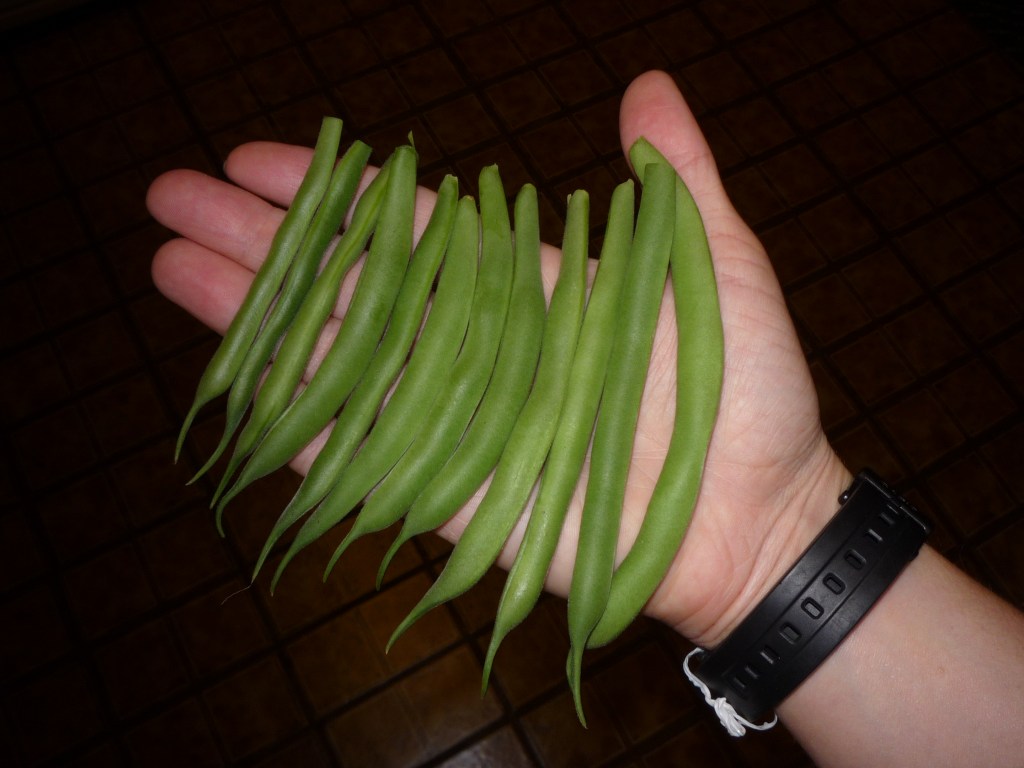
- Update: I consumed another batch of beany babies.
- Tool 3 Eat Local goal: track meatless days
- Update: I was a vegetarian for four days this past week and a half. The rest of the time I had chicken or fish for dinner.
- Tool 4 Buy Local goal: buy from local restaurants and no chains/fast food
- Update: Naught added to the fund.
- Tool 5 Turn Off The Lights goal: no phone until after breakfast and computer off by 9:30pm
- Update: I gave up on a bedtime goal because I can’t fall asleep until 1 or 2am even when I go to bed hours earlier.
- Tool 6 Consume Less Plastic goal: $5 fine for any disposable plastic utensils/straws/plates/cups
- Update: I’m adding $15 to the fund for free food that I received that came in a Styrofoam container and on a plastic plate with plastic wrap.
- Tool 10 Track Your Trash goals: look into composting
- Update: My compost bin will need some more time before I can determine whether it is working or not.
- Tool 10 Track Your Trash goal: turn off water in shower when not rinsing
- Update: $2 added to the fund for taking longer showers.
- Tool 11 Guzzle Less Gas goal: begin tracking gas/train/bike usage
- Update: I biked once since getting back from South Carolina.
- Tool 11 Guzzle Less Gas goal: calculate my carbon footprint and donate to offset fund!
- Update: See my story below.
- Continued tracking time.
- Update: I’m hoping to start practicing piano every day and of course I continue to catch up on my webinars and live-streamed concerts and Shakespeare.

Goals that I still need to implement:
- Tool 11 Guzzle Less Gas goals: conduct cost-benefit analysis of trading in my RAV4 for a hybrid or electric car
- Additional goals: look into new jobs, work on my college thesis for publishing
- Nothing New Fund for the past week: $17; Final total: $211
Goals that I will pursue after quarantine ends:
- Tool 3 Eat Local goals: look into IDEAS for Us farmers market
- Tool 6 Consume Less Plastic goal: only buy products with recyclable packaging for a period of time
- Tool 10 Track Your Trash goals: look into visiting a landfill, do the waste/water audit I created in college and carry trash
With what I added to my naught new fund this past week and a half, my total fund reached $211. During the past four months, I contributed to my naught new fund for various reasons that align with my goals, including for buying new things, for buying from chain restaurants, for bad technology habits, for the use of “disposable” plastic, and for using more water than I need. The purpose of fining myself for those things was for me to internalize the cost of my actions on the environment where there was not a cost factored into the price of an item. Now that my four months is coming to a close, I calculated my carbon footprint on various websites to see how much it would cost to offset what I was responsible for and compared that number to the amount of money in my fund that I would use to offset my carbon footprint.
I ended up using three carbon footprint calculators online: the EPA’s calculator, the one on carbonfootprint.com which is featured in Kristin Skarie’s book, A Year of Nothing New, and the one on TerraPass. Your carbon footprint is basically the addition of everything that you do that produces greenhouse gases through the use of fossil fuels to generate energy, including how much fuel you use during transportation and in your home in the form of electricity. The final number is either pounds or metric tons of carbon dioxide equivalent (CO2e), which means that all other greenhouse gases were calculated in terms of carbon dioxide. Different websites give different numbers, but the average carbon footprint of a person in the United States is 20 metric tons per year and a much lower number for the global average carbon footprint. Multiply that global average by 7.8 billion people on Earth and you get tens of gigatons (1 gigaton = 1 billion metric tons) of carbon dioxide going into the atmosphere every year. Such big numbers are difficult to fathom.
Luckily I had collected my mileage and train usage data for the past four months, so it was very easy to enter those numbers to calculate my carbon footprint. The websites all varied, but I can safely say that my carbon footprint for the past four months was between 2 and 3 metric tons. If I multiply that by 3 to get my average for the year, I would have emitted less than half of the U.S. average. Granted that half of my four months were spent in quarantine not using my car, my normal footprint would have been closer to the average footprint.


According to TerraPass, carbon offsets for my four month footprint would cost about $30 at the rate of $4.99 per 1,000 pounds of CO2e. That’s a lot less money than the $211 in my naught new fund. In case you are not familiar with what carbon offsets are, let me explain. In the society that we live in and the current way we produce energy (mostly from fossil fuels), there are many ways we can reduce our carbon footprint, but there is a point at which it is very difficult to go any lower. When we aren’t quarantined as a result of a global pandemic, most people must commute to work and use electricity. Something that individuals or businesses can do to help reduce their impact, however, is to purchase carbon offsets, which fund projects like renewable energy and methane capture, which replace fossil fuels and therefore help to cancel out your carbon emissions by eliminating them elsewhere. Disclaimer: Carbon offsets are not the solution to climate change on a larger scale because the carbon is still being emitted in the first place. However, I believe it is still a good action that you can take as an individual to help mitigate your impact.
There are multiple organizations that offer carbon offsets for purchase, and it is important to make sure that they aren’t scams. I think it is safest to go with the most well-known organizations, which can easily be found with a quick Google search for carbon offsets. The websites explain what projects your money will be going to so you know what you are funding. I have personally donated to The Carbon Fund in the past, and I went with TerraPass this time.
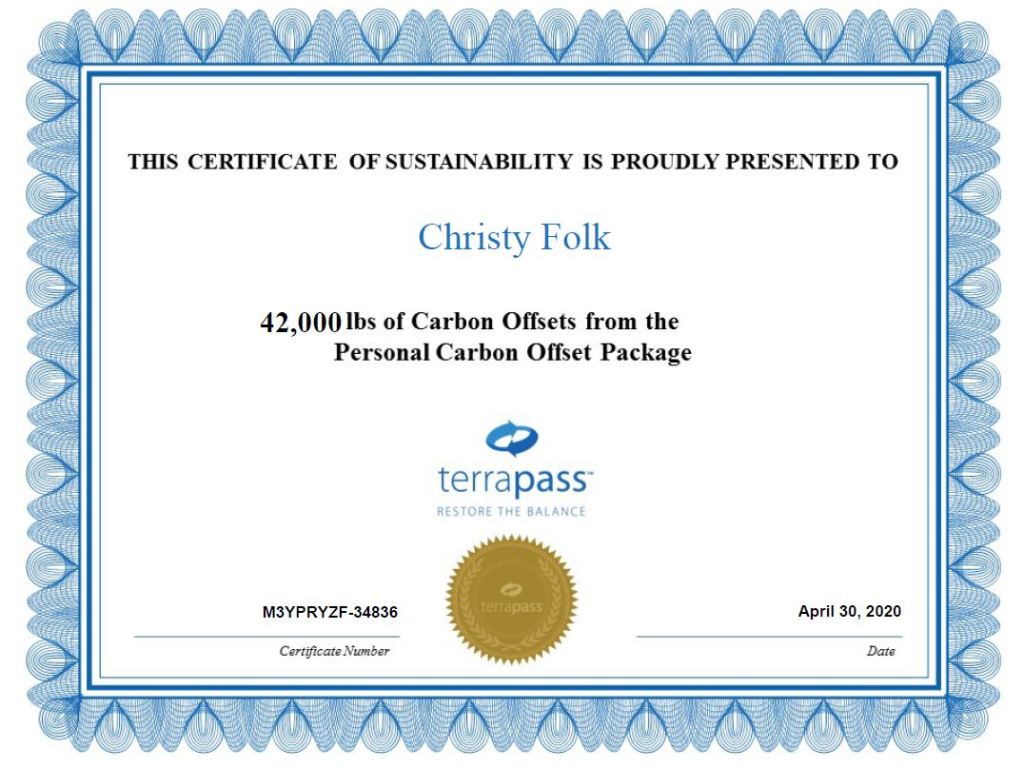
I purchased 42,000 pounds CO2e of personal carbon offsets from TerraPass and I spent $209.58, which is the closest I could get to my fund of $211. It is nice to know that I’m making up for the past couple of years of my carbon emissions while investing in the future of renewable energy.
Both the coronavirus pandemic and climate change are changing our world, so we need to use this opportunity to make it a cleaner and more just place for everyone. Calculate your carbon footprint, reduce it as much as you can, buy some carbon offsets, and may thee use naught new.
 Naught New
2 replies on “Week 16 and a half: Calculating carbon”
This is Awesome! Thanks for keeping us updated on your journey! I would love to share this with my community of teachers and students ❤
LikeLike
Of course, please do! Thanks for reading!
LikeLike